
Most people schedule an HVAC tune up in Orange City when their system breaks down in July—which is exactly when you don't want to discover what preventative maintenance could have caught. The real answer depends less on the calendar and more on what actually happens to equipment in Central Florida's climate cycle, which runs hotter and longer than most manufacturer guidelines assume.
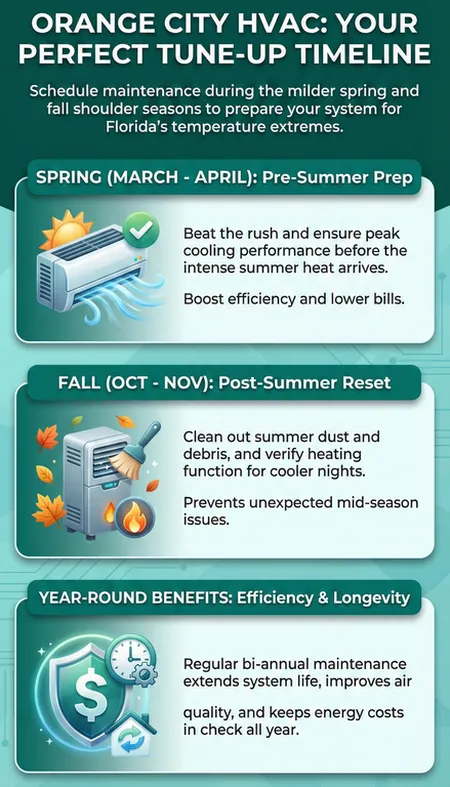
We've found that late winter and early fall create the most useful service windows, not because of textbook recommendations, but because technicians can actually diagnose marginal components before they fail under load. Scheduling your HVAC tune up in Orange City in February or October means the system gets examined when it's cycling normally—not in survival mode during a 95-degree afternoon when every unit on the block is maxed out.
TL;DR Quick Answers
What's the best time for an HVAC tune up in Orange City?
Late February or early October provides optimal diagnostic windows in Orange City's extended cooling climate. February catches issues before summer heat arrives, while systems run calmly enough for accurate testing. October reveals what survived June through September and addresses degradation before next season. Both timing windows avoid peak-season scheduling constraints and let technicians diagnose thoroughly rather than triage emergencies.
Top Takeaways
February and October tune-ups reveal different equipment conditions than peak-season service—both matter in climates running 3,000+ annual hours
Strategic timing means technicians diagnose problems calmly rather than triage failures, which finds issues before they cascade
Orange City's extended cooling season accumulates wear at nearly double national averages, making manufacturer service intervals inadequate
Humidity-related components like drain lines and evaporator coils show seasonal degradation that timing either catches or misses entirely
Annual versus bi-annual service depends on runtime, system age, and home conditions—not marketing calendars or generic recommendations
Why Timing Actually Changes What Gets Found
Most homeowners think a tune-up is just filter changes and refrigerant checks. The real value shows up when technicians can run systems through moderate loads and spot capacitors losing strength, contactors developing pitting, or drain lines starting to restrict before humidity peaks.
The February Window
February in Orange City hits that sweet spot after winter's mild heating demands but before spring humidity spikes. Components that weakened during the previous summer reveal themselves under basic testing without catastrophic failure masking secondary issues.
Condensate drains haven't fully colonized with algae yet. Ductwork leaks show up clearly with moderate temperature differentials. Refrigerant levels settle after months of lighter cycling, making accurate charging possible.
This surprises people: a system running hard doesn't always show problems clearly. It shows one big problem—usually the thing that just failed—while hiding three smaller issues that'll cascade later.
The October Opportunity
By October, your system has survived June through September. That's the real stress test in Central Florida, and equipment that made it through is either solid or hanging by a thread.
We schedule a lot of tune-ups in October because homeowners can actually see what six months of near-continuous operation did to their equipment. Compressor windings either held up or they're showing early temperature rise. Blower motors either handle the load or the bearings are announcing their decline.
The timing also beats the November-December rush when everyone suddenly remembers their heating system exists. You get better appointment windows and parts availability.
What The Calendar Doesn't Tell You
Spring tune-ups—March through May—get marketed heavily. They're fine. They're just not always better than February for diagnostic quality, and they put you in line with half your neighbors who all read the same seasonal reminder emails.
Summer tune-ups can happen, but if you're calling in July for preventative maintenance, you're either exceptionally disciplined or you've already had a scare. Most July service calls are repairs, not prevention.
The Twice-Yearly Approach
Some homes benefit from February and October checks. Not because HVAC companies want to sell more services, but because running 3,000+ hours annually in Orange City's climate wears equipment differently than the 1,500-hour annual average manufacturers use for service intervals.
Homes with pets, smokers, construction dust, or poorly sealed ductwork accumulate problems faster. Older systems operating near their efficiency limits benefit from more frequent monitoring.
Climate Reality vs National Recommendations
Standard HVAC advice says annual tune-ups before cooling season. That works in Charlotte or Nashville, where systems rest for six months.
Orange City runs cooling from March through November most years. Your equipment accumulates wear at nearly double the rate that generic manufacturer intervals assume. Your system legitimately experiences a full year's worth of national-average wear in about seven months.
"We've serviced thousands of systems in Orange City, and the ones running smoothest in August got looked at in February or October—not because those months are magic, but because equipment reveals different truths when it's not fighting for survival."
Essential Resources on HVAC Tune Up in Orange City
1. Energy.gov's Maintenance Checklist for Central Air Conditioners
Covers the technical tasks that professional maintenance should include, written from the Department of Energy's efficiency perspective. Useful for understanding what your technician should actually be checking beyond filter swaps.
https://www.energy.gov/energysaver/maintenance-checklist-central-air-conditioners
2. EPA's Guide to Indoor Air Quality and HVAC Systems
Explains how maintenance timing affects air quality, particularly relevant in Florida's high-humidity environment, where biological growth accelerates. Makes the case for consistency over convenience.
https://www.epa.gov/indoor-air-quality-iaq/improving-indoor-air-quality
3. ASHRAE's Residential Maintenance Standards
The technical foundation behind industry service intervals. More detail than most homeowners need, but it clarifies why Florida's climate demands adjusted maintenance frequency compared to national averages.
https://www.ashrae.org/technical-resources/standards-and-guidelines
4. Florida Building Commission's Energy Code Requirements
Outlines efficiency standards that affect how tune-ups get performed in Florida specifically. Good reference for understanding why proper refrigerant charging and airflow verification matter legally, not just practically.
https://www.floridabuilding.org/c/default.aspx
5. ACCA's Quality Installation Verification Resources
Helps homeowners understand what separates competent tune-up work from checkbox service. Especially useful for newer systems still under warranty, where installation defects sometimes masquerade as maintenance needs.
https://www.acca.org/standards/quality-installation-verification
6. SEER2 Standards Documentation from DOE
7. CDC's Guidance on HVAC and Ventilation for Healthy Indoor Environments
Addresses maintenance's role in health outcomes, particularly for households with respiratory concerns. Seasonal timing affects indoor air quality differently than just comfort or efficiency.
https://www.cdc.gov/coronavirus/2019-ncov/community/ventilation.html
Supporting Statistics
1. Systems receiving regular tune-ups maintain 95% of original efficiency, while neglected equipment loses 5% efficiency annually (Energy.gov)
A 16 SEER system becomes a 12 SEER system in just four years without maintenance
Efficiency loss shows up as higher bills, long before the system actually fails
Most homeowners blame summer heat rather than degraded performance
2. The EPA reports 25-40% of HVAC energy consumption gets wasted due to poor maintenance, inadequate airflow, or refrigerant issues
Systems run but don't perform efficiently
Homeowners think everything's fine because cold air comes out
Amp draw and temperature split measurements reveal compressors working twice as hard as they should
February and October tune-ups catch this before waste accumulates across entire cooling seasons
https://www.epa.gov/rhc/maintenance-and-operations-resources
3. Regular maintenance extends equipment lifespan by an average of 40%, moving typical system life from 10-12 years to 15-17 years (ACCA research)
That's a $6,000-8,000 difference in replacement timing for most Orange City homes
Savings dwarf tune-up costs
Only works if maintenance happens consistently—annual or bi-annual, depending on runtime
Not just when something sounds wrong
https://www.acca.org/resources
Final Thought and Opinion
Schedule your tune-up when the system can be honestly evaluated, not when it's convenient or when marketing says spring maintenance season arrived.
February and October work in Orange City because they represent bookends around your equipment's hardest working months—one before, one after.
If you're choosing only one window annually, October probably tells you more about your system's actual condition than any other month. It just went through battle.
Key exceptions:
New b from a six-month check regardless of season
Systems over twelve years old sometimes need eyes on them twice yearly
Age accelerates entropy in ways calendar recommendations don't account for
Frequently Asked Questions
Q1: Does it matter if I schedule my tune-up in April instead of February?
A: April works, but creates challenges:
You're competing with half your neighbors for appointment slots
Systems already running moderate loads that mask subtle issues
February gives better scheduling and calmer diagnostics
October serves the same function after summer rather than before
Q2: Can I skip tune-ups if my system seems to be running fine?
A: "Running fine" usually means "producing cold air"—which doesn't reveal:
Efficiency loss
Refrigerant drift
Electrical degradation
Restricted airflow
Problems develop gradually. By the time performance feels wrong, you've wasted months of elevated energy costs and accelerated wear.
Q3: Why do some companies recommend spring-only maintenance while others suggest fall service too?
A: Spring-only maintenance originated in climates with distinct seasons where systems rest half the year.
In Orange City:
Equipment runs March through November with minimal breaks
That runtime justifies bi-annual checks for most homes
Accumulated wear demands it—not company revenue goals
Homes with lighter usage or newer equipment sometimes get away with annual service
Q4: What's the real difference between a $79 tune-up special and a $200 comprehensive service?
$79 version typically covers:
Visual inspection
Maybe condensate drain treatment
Comprehensive service includes:
Refrigerant charge verification
Electrical connection testing
Capacitor measurement
Amp draw analysis
Temperature split documentation
You're paying for diagnostic depth that finds problems before emergencies versus basic maintenance that keeps things limping along.
Q5: If I wait until my system breaks to call for service, am I really losing that much money?
A: Emergency repairs cost 30-50% more due to:
Overtime rates
Rushed parts ordering
Limited technician availability
The higher cost is efficiency loss leading up to failure:
A degrading system wastes $20-40 monthly in excess energy before it quits
Add those months together, and you've spent the annual tune-up cost several times over
Then you still pay premium pricing for the inevitable breakdown
Schedule Smarter, Not Just Seasonally
The best time for your tune-up is before you need it to be—February and October both deliver that advantage in Orange City's year-round cooling demands. Pick the window that fits your schedule, then keep it consistent year after year so problems get caught early instead of expensive.
Here is the nearest branch location serving the Orange City area. . .
Filterbuy HVAC Solutions
2900 Titan Row # 128, Orlando, FL 32809
(407) 204-1859
https://maps.app.goo.gl/5gA5MYUv7Sc2EJLN8